
The rainforest around Cairns has a reputation that precedes it. People arrive expecting lush canopy, wildlife encounters, and that sense of stepping into something primordial. What they often find is more complicated. The walks are genuine, the forest is real, but the experience depends heavily on timing, fitness, and which track you choose. I’ve spent enough time on these trails to know which ones live up to the hype and which ones feel like a well-maintained tourist corridor with occasional trees.
The Daintree Rainforest dominates the conversation, and for good reason. It’s old growth, genuinely ancient, and the biodiversity is legitimate. But Daintree is also the most visited, most photographed, and most crowded option within an hour of Cairns. The main walking tracks there – Mossman Gorge, the Daintree Discovery Centre loop, the Cooper Creek Wilderness Trail – are well-constructed and safe. They’re also shoulder-to-shoulder with other visitors during peak season, especially between June and August. If you go, expect to share the experience. The gorge walk is short, around 2.7 kilometres, and the water is cold enough to be refreshing without being shocking. The forest canopy is dense, which means it’s usually quieter and cooler than the open areas around Cairns, but also darker and more humid.
Barron Falls and the Kuranda Range
Barron Falls Lookout is closer to Cairns than Daintree and requires significantly less time to reach. The walk itself is brief – about 1.6 kilometres return – but it offers something different: a dramatic vertical perspective. The falls drop 260 metres, and the lookout sits high enough that you get a sense of the rainforest’s scale without being immersed in it. The trade-off is obvious. You’re not walking through the forest; you’re looking at it from the outside. The track is paved and crowded, especially mid-morning. But if you’re short on time or your fitness level is limited, this delivers a genuine rainforest view without the commitment of a longer walk.
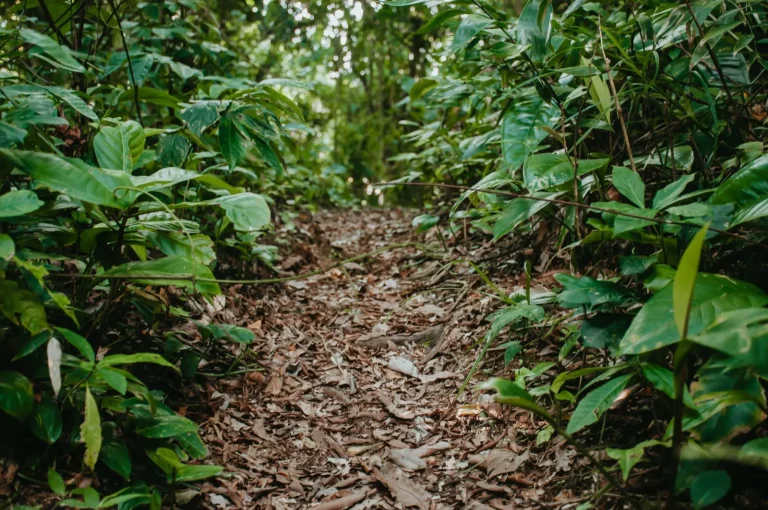
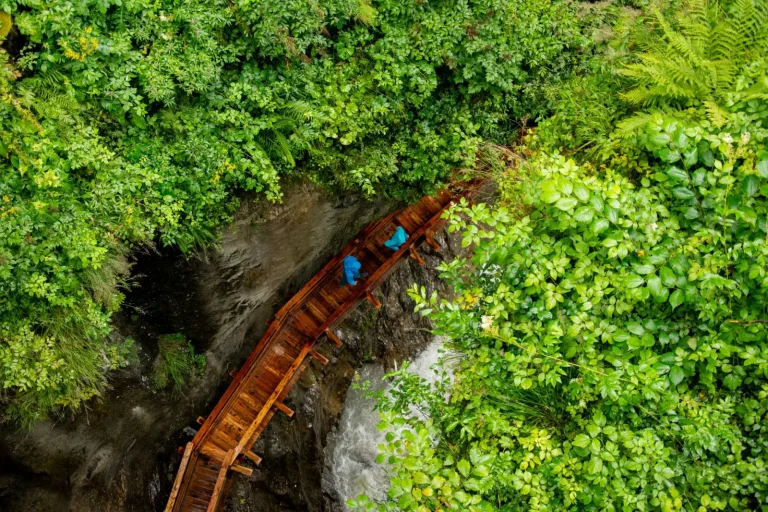
The Kuranda Range National Park has several options that sit between the tourist intensity of Mossman Gorge and the remoteness of deeper Daintree tracks. The Barron Falls walking track that descends into the gorge itself – not to be confused with the lookout – is steeper and more engaging. You’re actually moving through the forest, crossing creeks, and dealing with genuine elevation change. The humidity hits differently once you’re below the canopy. Sweat doesn’t evaporate; it just accumulates. The track can be slippery after rain, which is frequent enough that you should assume the ground will be damp even if it hasn’t rained that morning. The forest floor retains moisture for hours.
Crater Lakes and the Western Approach
If you want rainforest without the Daintree name recognition, Crater Lakes Circuit offers a different proposition. It’s about 45 minutes from central Cairns, sits in the Atherton Tablelands, and combines rainforest walking with volcanic landscape. The main loop is roughly 11 kilometres and takes between three and four hours depending on pace and how often you stop. The forest here is thick but not as old as Daintree. The lakes themselves are the main feature – clear, cold, and genuinely swimmable if you’re comfortable with the temperature. The track is well-marked and doesn’t require scrambling or technical navigation. What it does require is steady pacing and basic fitness. The elevation gain is moderate but consistent, and there’s no real flat section to recover on.
The advantage of Crater Lakes is solitude, relatively speaking. You’ll encounter other walkers, but not in the concentrated clusters you find at Mossman Gorge. The forest feels more like something you’re moving through rather than something you’re being funnelled past. The downside is logistics. The Tablelands sit at higher elevation, which means cooler temperatures but also more unpredictable weather. Mist and low cloud are common in the afternoon, which reduces visibility and can make the walk feel claustrophobic rather than immersive.
The Reality of Rainforest Walking
What doesn’t change across any of these walks is the basic physical reality of rainforest. It’s humid, it’s steep in places, and it’s slippery. Proper footwear matters more than people anticipate. Flat-soled shoes or thongs are a mistake. You need grip, ankle support, and something that drains quickly. The humidity means your feet will be wet, either from creek crossings or from sweat. Wet feet in poor shoes lead to blisters and twisted ankles, both of which are unpleasant when you’re still kilometres from the carpark.
Insects are present but rarely the problem people fear. Mosquitoes exist, but they’re not swarming unless you’re standing still in a particularly boggy area. Leeches appear after heavy rain, and they’re more of a psychological challenge than a physical one. They’re harmless but persistent. If you encounter them, salt or insect repellent works. The real annoyance is usually heat and humidity rather than wildlife. Most animals avoid walkers. You might see birds, occasionally a cassowary if you’re very lucky and very quiet, but the rainforest is not a zoo. You’re moving through an ecosystem that largely ignores you.
Timing shapes the entire experience. Early morning walks are cooler and quieter. By 10 a.m., the sun is high, the humidity is at its peak, and the carparks are full. If you start a walk after 2 p.m., you risk being on the trail as light fades, which is when navigation becomes genuinely difficult. The forest canopy is so dense that dusk arrives early. A walk that felt manageable at midday becomes disorienting in low light. Most of the established tracks have good signage and are difficult to get lost on, but the psychological experience changes significantly once the light starts to go.
Choosing Based on What You Actually Want
Mossman Gorge works if you want the classic rainforest experience, don’t mind crowds, and have limited time. It’s accessible, the water is cold and clear, and the forest is genuinely impressive. Barron Falls Lookout is for people who want a rainforest view without the physical commitment. Crater Lakes suits walkers who want solitude, don’t mind elevation gain, and are willing to drive 45 minutes. Daintree Discovery Centre and the Cooper Creek trail are middle ground – less crowded than Mossman but more established than backcountry options.
What matters most is matching the walk to your actual fitness level and time availability, not to what you think you should be able to do. The rainforest around Cairns is forgiving in terms of danger – the tracks are maintained and marked – but it’s unforgiving in terms of fatigue and humidity. An overestimated walk becomes a slog. A properly chosen walk becomes something you actually remember.