The Daintree rainforest sits in far north Queensland, and the word “ancient” gets attached to it so often that the claim has lost most of its force. But the label is not marketing. Spending time in the forest – moving through it, waiting in it, observing how light behaves and how species interact – reveals something genuinely different from other rainforests, even other old ones. The forest’s age is not just a number on a plaque. It shapes everything about how the place functions.
The Daintree has existed continuously for roughly 180 million years. That span is not metaphorical. While other rainforests were cleared, fragmented, or replaced during ice ages and climate shifts, this forest persisted. The geological record shows it survived the breakup of Gondwana, the arrival of humans, and climate fluctuations that would have eliminated less resilient ecosystems. That continuity matters because it allowed species to evolve in isolation, to specialize, and to develop relationships with one another that exist nowhere else on Earth.
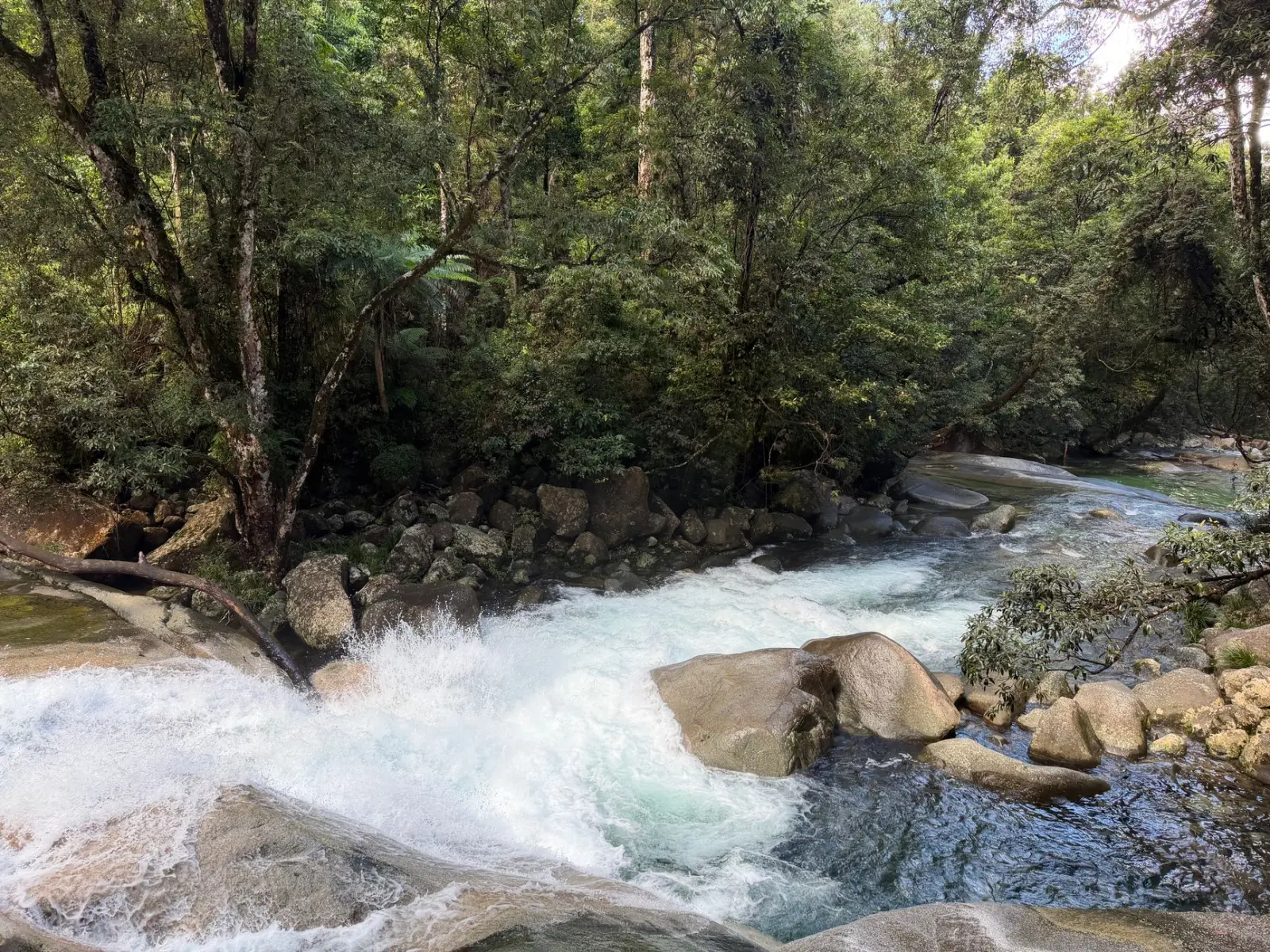
Walking through the Daintree, the first thing that strikes most visitors is the density and layering. The canopy is not a single flat plane but a complex architecture of strata, each with its own light regime, humidity, and species composition. The tallest emergent trees reach up to 60 meters, but beneath them are multiple understory layers, then the shrub layer, then the forest floor itself. This vertical complexity is not accidental. It reflects millions of years of species packing themselves into available niches, each finding a specific height, light condition, or moisture level where it could outcompete others.
Why Age Creates Irreplaceable Diversity
Older rainforests accumulate species in ways younger forests cannot. In the Daintree, you encounter plants and animals found nowhere else because they evolved here and never dispersed. The forest contains around 30% of Australia’s frog species despite covering less than 0.1% of the country’s land area. Many of these frogs are small, cryptic, and highly specialized. Some breed only in water trapped in tree holes. Others have evolved to lay eggs on leaves above streams, with tadpoles dropping into water below. These are not random variations. They are solutions to problems posed by a specific forest structure that has remained largely stable for millions of years.
The presence of primitive plant lineages reinforces this pattern. The Daintree contains living fossils – plants that belong to families that dominated the Mesozoic era. Cycads, primitive conifers, and ancient flowering plants grow here. These are not relics that somehow survived elsewhere; they are thriving components of the living forest. Their presence indicates that the forest’s basic structure and function have remained compatible with their needs across geological timescales. Younger rainforests, even old ones, typically lack this deep evolutionary history embedded in their flora.
The soil itself carries evidence of this continuity. Rainforest soils are generally poor in nutrients because heavy rainfall leaches minerals away and decomposition happens rapidly in warm, wet conditions. But the Daintree’s soil reflects 180 million years of accumulated organic matter, weathered rock, and nutrient cycling. The forest has learned to function with its own limitations. Nutrients cycle tightly between living biomass and the soil. Root systems are shallow and efficient. Mycorrhizal networks – fungal associations with plant roots – are highly developed. The forest does not fight its conditions; it has adapted to exploit them completely.
Isolation as an Evolutionary Engine
The Daintree’s location on the Australian continent has been crucial to its uniqueness. Australia drifted north from Gondwana, gradually becoming warmer and drier. Rainforests retreated to the wetter regions of the north and east. The Daintree and a few other rainforest patches became isolated islands of wet forest surrounded by drier vegetation. This isolation prevented gene flow with other rainforests. Species could not migrate. They either adapted to local conditions or went extinct. Over millions of years, this isolation produced high rates of endemism – species found nowhere else.
The isolation also meant the forest developed without large placental mammals. Australia’s megafauna – the giant wombats, kangaroos, and other large animals – never reached the Daintree in significant numbers. The forest’s structure and seed dispersal systems evolved without pressure from large browsing animals. This is not a minor detail. It means the forest’s architecture, the size and spacing of trees, the production of seeds and fruits, and the entire food web reflect a world without megafauna pressure. Introduce large animals, and the forest’s balance shifts.
Human presence in the Daintree extends back at least 12,000 years, possibly much longer. Aboriginal peoples lived in and used the forest, but their impact was fundamentally different from European land use. They did not clear the forest wholesale or introduce large herbivores. The forest’s structure when Europeans arrived reflected a long equilibrium between human use and forest regeneration. That equilibrium is now disrupted, but the point remains: the forest’s current character reflects not just its age but its history of interaction with specific human populations.
The Practical Reality of Ancient Forest Structure
Visitors often expect the Daintree to feel primordial or untouched, and in some ways it does. But ancient does not mean static or unchanging. The forest is dynamic. Trees fall. Gaps open. Species composition shifts. What makes the forest ancient is not that it is frozen in time but that its processes of change operate within a framework established millions of years ago. A fallen tree creates a gap, and the gap fills with pioneer species adapted to high light. Those pioneers eventually shade out, and slower-growing shade-tolerant species take over. This cycle has repeated countless times in this forest.
The canopy in the Daintree is notably closed. Light penetration to the forest floor is minimal – often less than 1% of above-canopy light reaches ground level. This darkness is not a bug; it is a feature. The forest’s species have evolved to function in deep shade. Seeds germinate in low light. Seedlings grow slowly but persistently. Fungi and decomposers work efficiently in the moist, dark conditions. The closed canopy also regulates water. It buffers temperature fluctuations and maintains high humidity even during dry seasons.
Moving through the forest is slow work. The terrain is often steep. Fallen trees, roots, and dense understory vegetation create obstacles. Visibility is limited. Sound behaves differently in the dense forest – it is absorbed rather than reflected, creating an acoustic environment that feels enclosed and intimate. These are not obstacles to overcome but characteristics of how the forest actually functions. The slowness, the density, the limited visibility – these are features that have allowed the forest to persist and specialize.
The Daintree’s uniqueness ultimately rests on a combination of factors that rarely align. It requires geological stability to allow continuous forest cover. It requires isolation to prevent homogenization with other forests. It requires appropriate climate to support rainforest growth. It requires time – vast stretches of time – for species to evolve, specialize, and develop the intricate relationships that characterize old forests. The Daintree has all of these. That is why it remains genuinely irreplaceable, not as a tourist destination but as an ecological system.