
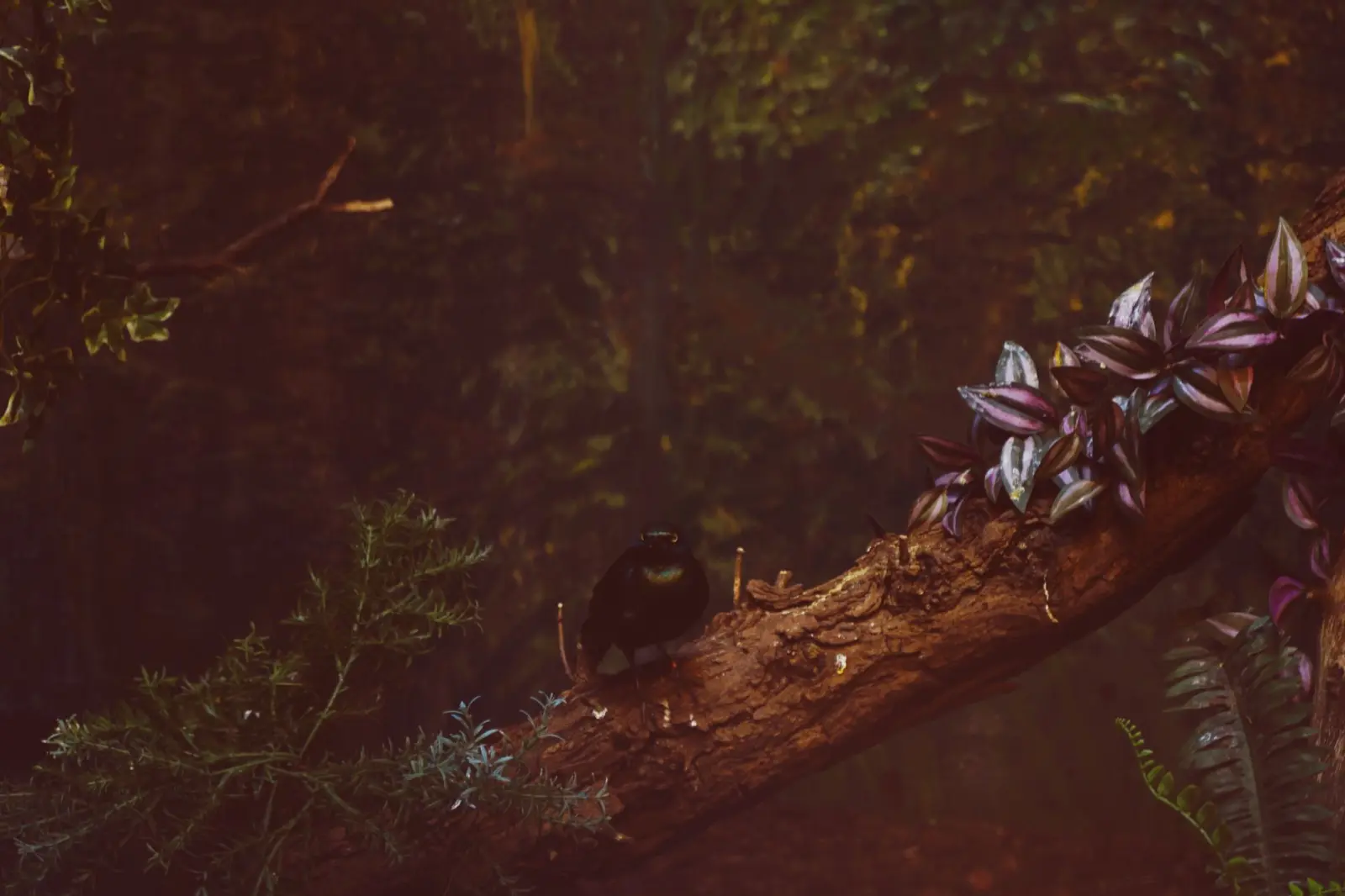
Watching a male Victoria’s riflebird perform his courtship display is one of those experiences that stays with you. The first time I observed one, I wasn’t prepared for how deliberate and theatrical the performance actually is. He had cleared a small patch of forest floor – his stage – and when a female approached, what unfolded was less like natural behavior and more like a choreographed act that had been refined over countless generations. The bird’s entire body seemed to transform. His plumage, normally dark and relatively unremarkable, suddenly became animated. His tail fanned upward, his wings snapped open and shut in rapid succession, and he produced a series of mechanical clicking and whirring sounds that echoed through the dense canopy understory.
The rainforest where these birds live is unforgiving. It’s wet, dark, and densely packed with vegetation that makes movement difficult even for small creatures. Victoria’s riflebirds are found in the rainforests of northeastern Australia, primarily in Queensland, where they occupy a very specific ecological niche. They are not common birds, and their range is fragmented across patches of suitable forest. The habitat they depend on is characterized by dense undergrowth, tall emergent trees, and a thick canopy that filters most direct sunlight to the forest floor. This environment shapes everything about how they live, breed, and survive.
The Courtship Stage
Male Victoria’s riflebirds are obsessive about their display sites. They don’t just perform anywhere – they prepare specific patches of forest floor by removing leaf litter, twigs, and debris until they have a relatively clear, dark stage. Some males maintain multiple display sites, and they visit them regularly, often spending considerable time clearing and maintaining them. The investment in this preparation is significant given the energy demands of rainforest life. When a female enters the vicinity, the male’s behavior shifts immediately. He positions himself on his cleared stage and begins the display.
The performance itself is rapid and intense. The male’s body posture changes dramatically – he crouches, extends his tail vertically, and spreads his wings in a way that momentarily expands his apparent size. The mechanical sounds he produces are distinctive and somewhat jarring in the quiet understory. These vocalizations are not melodious or musical; they are sharp, percussive, and clearly designed to capture attention. The entire display typically lasts only a few seconds, though the male may repeat it multiple times if the female remains nearby. What strikes you most is the precision of it all. Every movement appears calculated, every sound timed. There is no hesitation or variation – it is the same sequence, performed with mechanical consistency.
Female Victoria’s riflebirds are far less conspicuous. They lack the specialized plumage and behavioral displays of males, and they move through the forest with minimal fanfare. Their role in courtship is essentially to evaluate the male’s performance and decide whether he is worth breeding with. This asymmetry – where males invest heavily in display and females invest in careful selection – is common in birds where males cannot contribute to chick-rearing. In this species, once mating occurs, the female is solely responsible for nest construction, incubation, and chick care. The male’s only contribution is his genes and the display that convinced the female he was worth choosing.
Survival in Dense Forest
The rainforest environment presents constant challenges. Food availability is patchy and seasonal. Victoria’s riflebirds are primarily frugivorous, feeding heavily on fruits from rainforest trees, though they also take insects and small vertebrates opportunistically. The abundance of fruit fluctuates dramatically depending on which trees are fruiting at any given time. During lean periods, birds must travel considerable distances to find adequate food sources. The dense canopy makes foraging visually challenging – much of the food hunting occurs by sound and memory of where productive trees are located.
Predation is another constant pressure. Raptors hunt in the rainforest, and snakes pose a significant threat to eggs and chicks. Nesting females must balance the need to incubate their eggs with the need to forage and maintain body condition. Nests are typically built in the fork of a tree or in dense vegetation, positioned to provide some concealment. The female spends extended periods on the nest, making her vulnerable to predators. The incubation period is relatively long, and chicks take considerable time to fledge. During this entire period, the female must maintain sufficient body weight and condition to survive, despite the energy demands of reproduction.
Disease and parasites are less visible threats but no less real. Rainforest birds carry various blood parasites and endoparasites. Humidity and warm temperatures in the rainforest create ideal conditions for parasite transmission. Feather condition is critical for rainforest birds – waterproofing and insulation are essential given the constant moisture. Males spend considerable time preening and maintaining their plumage, particularly their display feathers, which must be in pristine condition for courtship to be effective.
Territorial Behavior and Space
Male Victoria’s riflebirds are territorial, though their territories are not as rigidly defined as in some other bird species. Males defend areas around their display sites, but the boundaries are somewhat fluid. Encounters between males can be aggressive, with physical combat occurring occasionally. However, much of the territorial behavior is expressed through vocalizations and displays rather than direct fighting. A male will produce loud calls from prominent perches within his territory, advertising his presence and warning other males to stay away.
The spacing of males across the landscape appears to be related to the distribution of fruiting trees and suitable display habitat. In areas where food is abundant and scattered widely, males maintain larger territories with greater spacing between them. In areas where food resources are more concentrated, territories may be smaller and males may be found in closer proximity. This flexibility suggests that males adjust their space use based on ecological conditions rather than following a fixed territorial system.
Females do not appear to be strictly territorial in the same way males are. They move through the forest more widely, following food sources and visiting multiple male display sites before selecting a mate. This mobility allows them to compare males and make informed breeding decisions. The mating system is essentially polygynous – females mate with a single male, but males may mate with multiple females if they can attract them to their display sites.
Seasonal Patterns and Breeding
Breeding in Victoria’s riflebirds is seasonal, though the exact timing varies somewhat depending on local conditions and food availability. The breeding season generally peaks during the Australian spring and early summer, when fruit availability is increasing and day length is extending. Males begin displaying more intensively as the breeding season approaches, and their display sites become more actively maintained.
The entire breeding cycle – from courtship through fledging – takes several months. Females typically raise only one or two chicks per season. The investment per chick is substantial, and reproductive success is far from guaranteed. Many nesting attempts fail due to predation, weather events, or inadequate food availability. In years when fruit production is poor, breeding success drops noticeably. Some females may not breed at all if conditions are unfavorable.
What I have observed repeatedly is that Victoria’s riflebirds are not resilient to habitat loss or fragmentation. Their dependence on intact rainforest, their relatively low reproductive output, and their limited range make them vulnerable to environmental change. The rainforest patches where they occur are increasingly isolated, and this isolation affects gene flow between populations. The species persists, but it does so in a precarious state, dependent on the continued existence of suitable rainforest habitat. Understanding their courtship and behavior is not merely academic interest – it reflects the complexity of survival in one of the world’s most challenging ecosystems.