
Spend enough time in a rainforest and you realize the experience is fundamentally acoustic. The birds are there – dozens of species within earshot at any given moment – but they remain invisible behind walls of green. This isn’t accidental. It’s how rainforest birds operate. The density of vegetation, the competition for space, and the sheer abundance of life in these ecosystems have shaped behavior in ways that make sound far more practical than visibility.
I’ve walked through rainforests across Central America, the Amazon, and Southeast Asia, and the pattern is always the same. Your guide points upward at a canopy you cannot penetrate. A bird calls from somewhere in that mass. You listen. Nothing moves. The bird calls again, closer or farther, and your guide nods knowingly. This is normal. This is how it works. Most people find this frustrating at first. The disconnect between the richness of sound and the scarcity of sightings can feel like a missed opportunity. But it’s actually the opposite. The sound is the experience.
Why Visibility Fails in Dense Forest
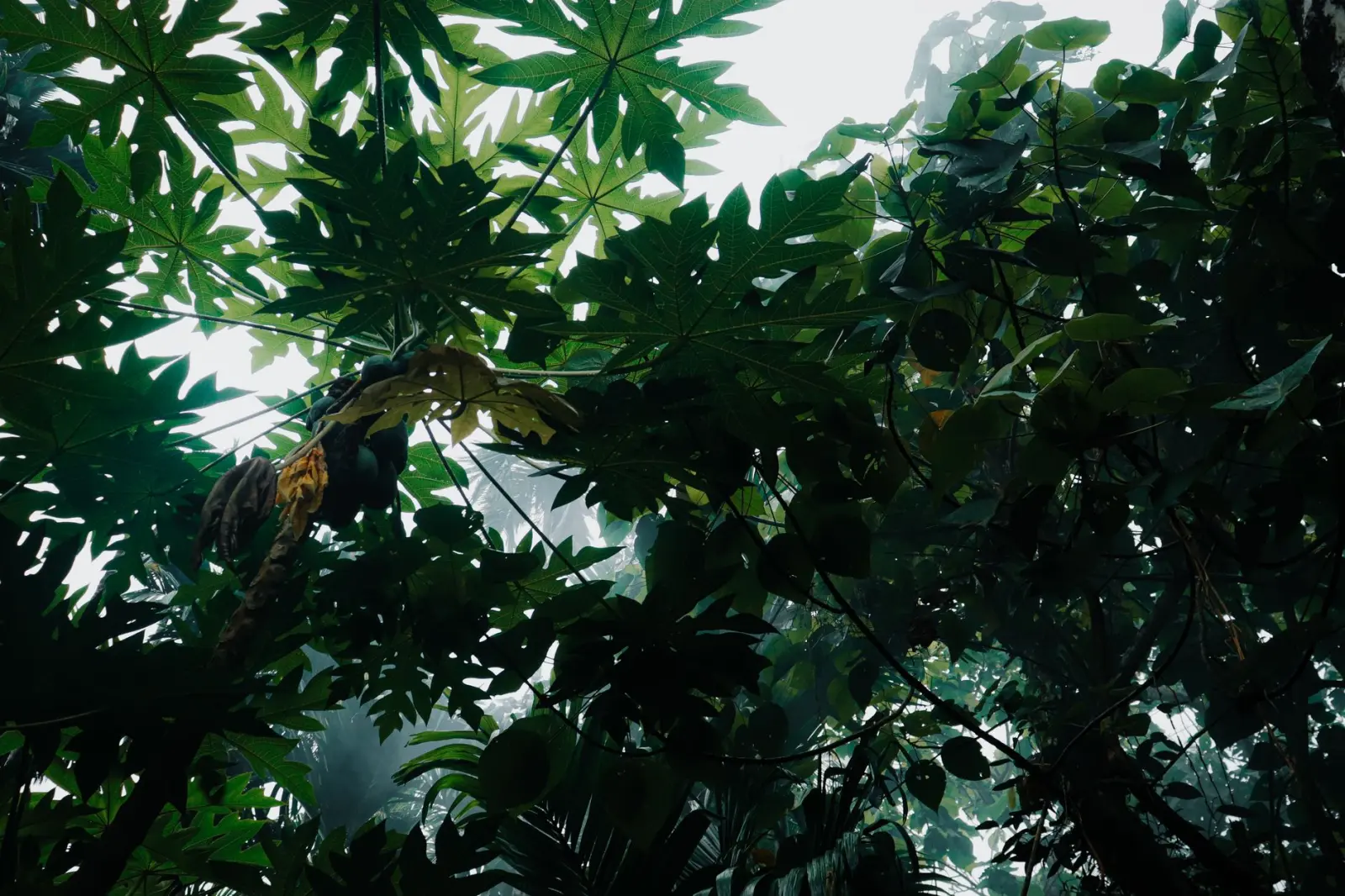
A rainforest canopy is not like a temperate forest. Trees don’t stand in neat rows with clear sight lines between trunks. Instead, vegetation layers overlap completely. Epiphytes – orchids, bromeliads, ferns – cling to branches. Lianas twist through the understory. The ground itself is a tangle of fallen logs, saplings, and dense shrub growth. A bird ten meters away might as well be a hundred meters away if it’s positioned behind a cluster of leaves.
This density creates a real constraint on how birds can communicate and hunt. A macaw or toucan might be audible across the entire forest, but visual signals become useless almost immediately. A bird displaying its plumage to a potential mate or rival would be wasting energy if no one could see it from more than a few meters away. Sound, by contrast, travels. It carries information across barriers. It works in dim light. It works at night. Over evolutionary time, rainforest birds have invested heavily in their voices and relatively less in visual display compared to birds in open habitats.
The Calls You’re Most Likely to Encounter
Early morning is when the forest is loudest, particularly between dawn and two hours after sunrise. This is when birds are most active, feeding, and calling to establish territory or find mates. The diversity of sounds can be disorienting if you’re not used to it. Some calls are unmistakable – the loud, repetitive “per-per-per” of a chachalaca, the deep hooting of a tinamou, the piercing screams of macaws. Others are subtle: soft chirps, trills, and whistles that blend into the general forest noise.
One of the most common experiences is hearing a large bird – something substantial, something you’d expect to see – and finding nothing. A howler monkey’s roar sounds like it’s coming from a tree thirty meters away, but the animal is often much farther, and the sound has simply traveled well. Similarly, the loud, harsh calls of certain tanagers or the booming notes of a wood-quail can seem impossibly close while the bird remains completely hidden. This is partly due to how sound behaves in humid, dense environments. It reflects off leaves and trunks in unpredictable ways. Your brain struggles to triangulate the source.
Toucans are a good example of the visibility problem. Their calls are loud and distinctive – a repetitive, frog-like croaking that carries across the canopy. But toucans spend most of their time perched high in emergent trees, often silhouetted against the sky in ways that make them nearly impossible to spot without knowing exactly where to look. Your guide might hear a toucan and know its location precisely, but a visitor scanning the canopy will see only leaves and sky.
What the Sounds Actually Tell You
After a while, you start to recognize patterns. Certain calls indicate feeding activity. Others signal territorial disputes. Some are alarm calls – a bird warning others of a predator or disturbance. The intensity and frequency of calling often correlates with the time of day, the weather, and the season. A sudden silence in the forest is notable. It usually means something has disturbed the birds – perhaps a large predator, perhaps just a human moving too quickly.
The most experienced guides develop an almost intuitive sense of what’s happening based on sound alone. They can identify species, estimate numbers, and gauge activity levels without seeing a single bird. This skill develops through repetition and attention. You learn to filter out background noise. You learn which calls belong to which species. You learn the difference between a bird that’s nearby and a bird that’s far away. You learn that a sudden change in calling patterns often precedes a sighting, if you’re patient enough to wait.
Certain species are more vocal than others, and this partly determines how often you’ll hear them versus see them. Antbirds, for instance, are relatively vocal and often stay in the understory where visibility is limited. Hummingbirds are quieter and often visible when they do call. Parrots are loud and social, making them easier to locate by sound, though still difficult to see clearly. Owls are nocturnal and highly vocal at night, creating an entirely different acoustic landscape than the daytime forest.
The Practical Reality of Rainforest Birdwatching
If you’re traveling to a rainforest expecting to see birds the way you might in an open woodland or savanna, you’ll be disappointed. The forest simply doesn’t work that way. But if you adjust your expectations and treat the acoustic experience as primary, the forest becomes rich and rewarding. A good guide will stop frequently, listen, and identify birds by sound. They’ll explain what you’re hearing and why. This is how most rainforest birding actually happens – through listening, learning, and occasional glimpses of movement or silhouettes.
Patience matters more than movement. Sitting quietly in one spot for twenty or thirty minutes often yields more sightings than walking constantly. The birds adjust to a stationary human faster than they adjust to a moving one. Early morning is essential – the forest is simply more active then. Weather affects activity significantly; heavy rain suppresses calling, while overcast mornings often produce intense calling activity.
The frustration many travelers experience – hearing birds everywhere but seeing almost nothing – is not a failure of the experience. It’s the reality of rainforest ecology. The birds are there. They’re communicating, hunting, nesting, and living their lives. You’re hearing evidence of that life, even if you’re not seeing it directly. Over time, this shifts from feeling like a limitation to feeling like a privilege. You’re hearing a world that most people never access, even when they’re standing right in the middle of it.