
Spending time in a rainforest at night is fundamentally different from a daytime visit. The forest doesn’t simply dim – it transforms into an entirely separate operating system. I’ve guided countless visitors through tropical rainforests across Central America, Southeast Asia, and the Amazon basin, and the moment the sun dips below the canopy, the animal behavior shifts so dramatically that you’re essentially in a different habitat, even though you’re standing in the same location.
Most travelers encounter rainforests during daylight hours, which means they miss roughly half of the ecosystem’s activity. This isn’t a minor detail. The nocturnal shift represents a fundamental reorganization of who is active, how they hunt, how they communicate, and what risks they face. If you understand this rhythm, you understand the rainforest itself.
The Transition Period and Crepuscular Activity
The hour or two around sunset is when you notice the most obvious change. Diurnal birds – toucans, macaws, tanagers – become increasingly vocal and frantic as they settle into roosting spots. This isn’t random noise. They’re competing for safe positions in the canopy, away from predators that are just beginning to stir. At the same time, you’ll hear the first calls of animals that were silent all day: howler monkeys intensifying their vocalizations, night birds beginning their emergence, insects shifting their pitch and frequency.
This crepuscular period – the twilight hours – is actually one of the most active times in the forest. Many predators are most active during this window because prey species are moving between day and night refuges. Jaguars, ocelots, and snakes are more likely to hunt during these transition hours than in the deep night. If you’re moving through the forest during this time, you’re statistically more likely to encounter a large predator than at any other hour, though actual encounters remain rare if you’re making noise and staying alert.
Nocturnal Predators and Hunting Strategies
Once full darkness settles, the forest’s predator guild shifts almost entirely. Snakes become the dominant hunters at ground level. Pit vipers, fer-de-lances, and various non-venomous species are actively foraging, using heat-sensing pits or simple ground vibration detection to locate prey. I’ve encountered dozens of snakes on night walks, and the pattern is consistent: they’re hunting rodents, frogs, and occasionally small birds. They’re not aggressive toward humans unless stepped on or directly threatened, but their presence is constant in ways that are invisible during the day.
Larger nocturnal predators – jaguars, pumas, ocelots – are also hunting, but they operate at a different scale and in different microhabitats. They’re not randomly patrolling; they follow trails, water sources, and areas where prey concentrates. In my experience, the real nocturnal predator activity happens in the understory and on the forest floor, not in the canopy where many visitors imagine jungle danger originates.
Owls become the dominant aerial predators after dark. The variety is often surprising: spectacled owls, barn owls, various smaller species. They hunt insects, small mammals, and occasionally birds. Their calls are among the most distinctive sounds of a rainforest night, and many visitors find them unsettling precisely because they’re so different from daytime acoustic patterns.
Amphibian Chorus and Acoustic Ecology
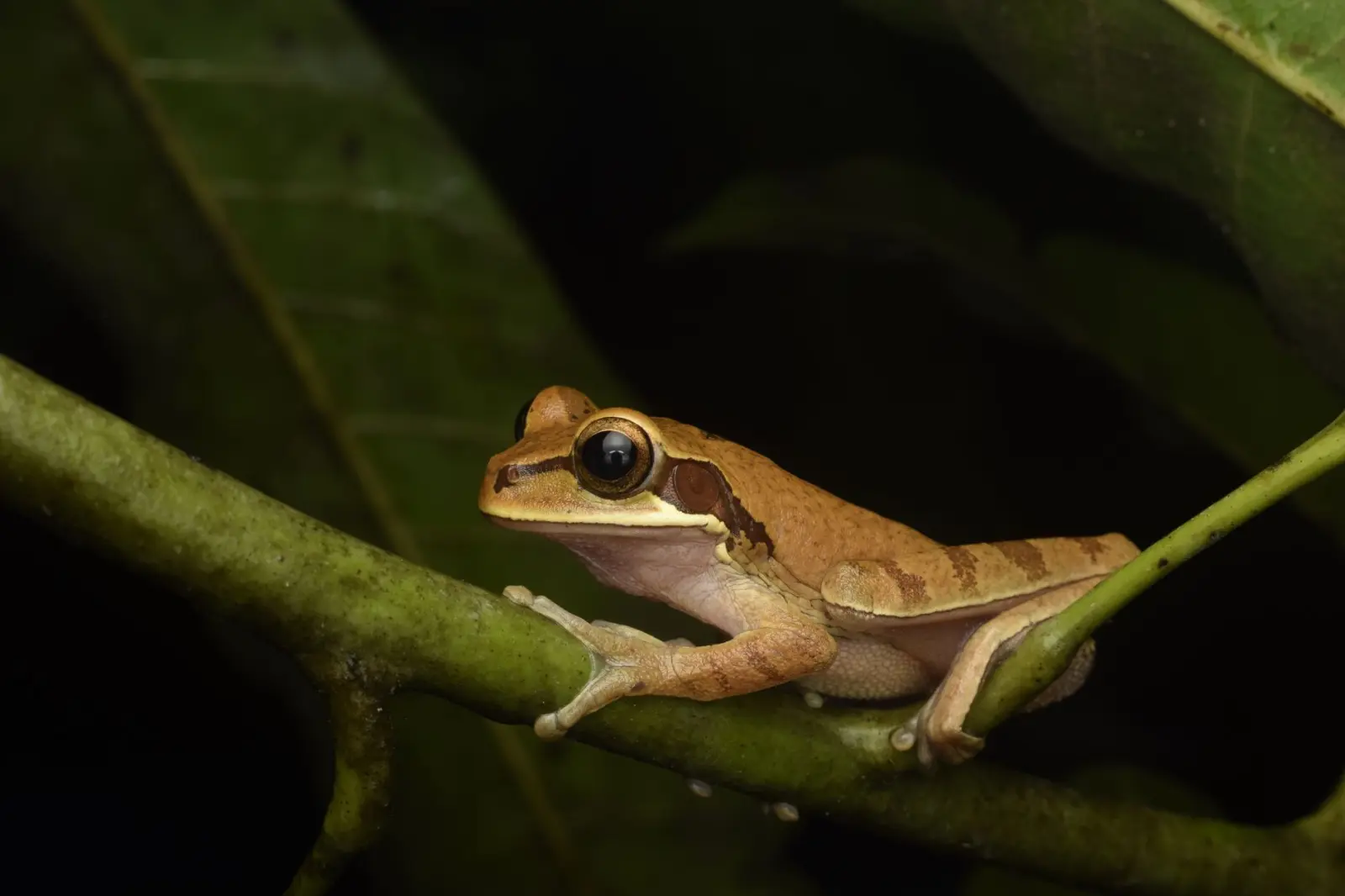
If you’ve never heard a rainforest at night, the sound is almost overwhelming. The noise isn’t random – it’s a precisely structured communication system, and understanding it changes how you perceive the forest entirely. Frogs dominate this soundscape, and they’re not just making noise for the sake of it. Each species has a specific call, a specific pitch, and a specific time window when it’s most active.
The frog chorus serves multiple functions simultaneously: territorial advertisement, mate attraction, and species recognition. Males call from specific locations – on leaves, in water, in tree holes – and females locate them by sound. The timing is critical. Some species call only in the first few hours after sunset. Others peak around midnight. Still others are most active in the pre-dawn hours. This temporal partitioning allows dozens of frog species to coexist in the same area without their calls completely masking each other, though the overall volume is still staggering.
What many visitors don’t realize is that this acoustic activity is also a predation risk. Frog-eating bats locate their prey by listening to calls. Snakes and other predators use sound to find frogs. The very act of calling to attract a mate exposes the caller to predation. This is why frog activity patterns shift based on predation pressure, moon phase, and humidity. A night with high predation pressure from bats will have noticeably fewer calls than a night with low predation risk.
Nocturnal Mammals and Arboreal Activity
The canopy and mid-story of the rainforest come alive at night with mammals that are completely inactive during the day. Kinkajous, coatis, opossums, and various nocturnal rodents become active foragers. These aren’t the large, charismatic animals that visitors hope to see, but they’re far more abundant and far more important to forest ecology than the big cats that dominate tourist expectations.
Nocturnal primates like night monkeys are active in some rainforests, though they’re difficult to observe even with a light. What you’re more likely to encounter is evidence of their activity – knocked-down fruit, disturbed vegetation, vocalizations. The forest floor at night is also active with small mammals: agoutis, pacas, various rodents. These animals are crucial seed dispersers and prey species for the nocturnal predators I mentioned earlier.
The activity level of these nocturnal mammals is directly tied to food availability. When fruiting trees are producing heavily, nocturnal mammal activity increases dramatically. When food is scarce, they range more widely and are more likely to be encountered on trails. This is one of the reasons that night walks can be unpredictable – the forest’s nocturnal activity is responsive to seasonal and even daily changes in resource availability.
Sensory Adaptations and Visibility
Observing nocturnal rainforest wildlife requires accepting that you’re operating with severe sensory limitations. Even with a good flashlight, you see perhaps 10 percent of what’s actually happening around you. Most nocturnal animals are adapted to low light conditions in ways that make them difficult to detect with artificial light. Many have reflective eye shine, but many others don’t. A snake on a branch might be completely invisible until you’re within a meter of it.
This is why night guides in rainforests develop a different skill set than daytime guides. They’re listening more than looking. They’re tracking movement by sound and vibration. They’re reading the forest’s responses – how animals react to your presence, where activity is concentrated, what the overall acoustic pattern tells you about predation risk and prey availability. A good night guide can tell you what’s happening in the forest without necessarily seeing it directly.
The use of red light versus white light changes what you observe. Red light is less likely to disturb nocturnal animals, but it also makes it harder for humans to see detail. White light reveals more but causes animals to freeze or flee. Most experienced guides use a combination, adjusting based on what they’re trying to observe and what animals are present.
Nocturnal rainforest activity is ultimately a reflection of the forest’s fundamental ecology. The animals that emerge after dark are not marginal to the ecosystem – they’re central to it. They process the majority of the forest’s biomass, they drive predator-prey dynamics, and they shape the forest’s structure through their feeding and movement patterns. Understanding this nocturnal world requires patience, acceptance of uncertainty, and a willingness to observe without always comprehending what you’re seeing. The rainforest at night operates on principles that are different from those that govern daytime activity, and those differences reveal something essential about how tropical ecosystems actually function.