
Spending time observing tree kangaroos in their native rainforest habitat reveals something counterintuitive about their existence. These animals move through the canopy with a deliberateness that seems almost labored compared to other arboreal creatures, yet they persist in an environment where most ground-dwelling mammals would fail within hours. The transition from terrestrial to arboreal life didn’t happen overnight, and the anatomical compromises they made tell a story about survival under specific environmental pressures rather than a clean evolutionary victory.
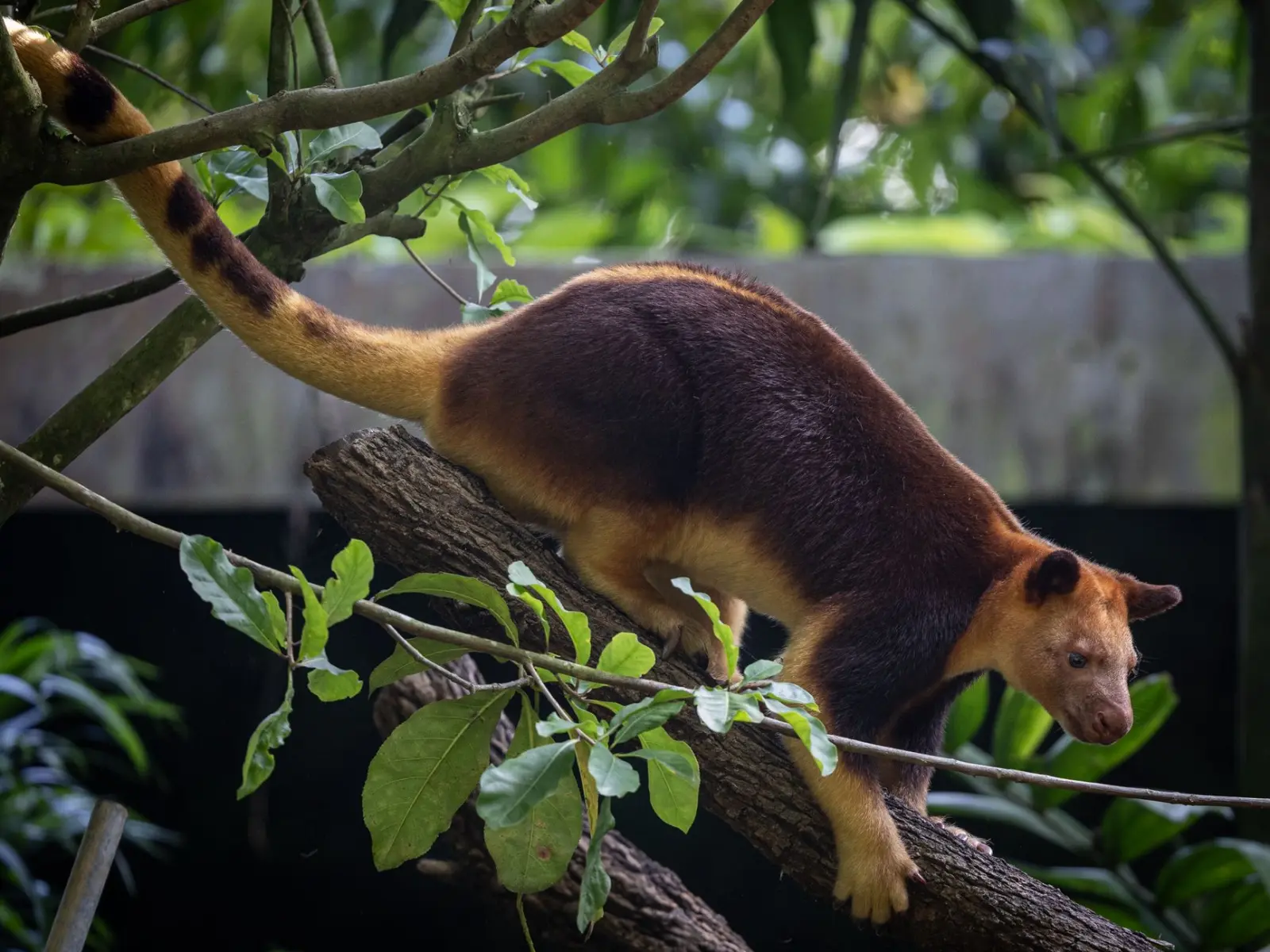
The most obvious adaptation is structural. Tree kangaroos possess shorter, more powerful hind legs than their ground-dwelling relatives, with feet that have evolved to grip branches rather than push off against earth. The soles of their feet are rougher, almost leathery, providing friction against bark. Their claws are longer and curve more sharply than those of terrestrial kangaroos, designed to hook into crevices and rough surfaces. When you watch them move, you notice the hind feet work almost like a climber’s crampon – they’re not elegant, but they’re effective. The tail, which serves as a counterbalance and propulsion device on the ground, has become shorter and less muscular in tree kangaroos. This isn’t a loss of function so much as a reallocation of resources. A long tail would be a liability in dense vegetation, catching on branches and throwing off balance.
The Forelimb Problem
The real anatomical compromise lies in the forelimbs. Kangaroos, both terrestrial and arboreal, are built around powerful hind legs and a relatively weak upper body. Tree kangaroos have longer, stronger forelimbs than their ground cousins, with better developed shoulders and more flexible joints. Their arms can reach further and grip with more precision. Yet even with these improvements, they remain less adept climbers than primates or many other arboreal mammals. The forelimbs are still short relative to body length, and the grip strength, while improved, never matches that of a monkey or gibbon. This limitation shapes how tree kangaroos move through their environment. They don’t swing. They don’t leap dramatically between distant branches. Instead, they climb methodically, often moving to thicker branches and using their body weight to feel out stability before committing fully.
The spine and torso have undergone subtle but important changes. Tree kangaroos have a more flexible spine than terrestrial kangaroos, allowing them to arch and twist in ways necessary for navigating three-dimensional space. Their center of gravity has shifted slightly forward compared to ground-dwelling species, which helps with climbing but reduces the explosive jumping ability that makes terrestrial kangaroos such efficient hoppers. This is the core trade-off: they gained the ability to move upward, but they lost the ability to move quickly forward across open ground. A tree kangaroo on flat earth is a vulnerable animal.
Behavioral Adaptations That Matter
The physical changes alone don’t explain how tree kangaroos survive. Their behavior has shifted just as dramatically. They are primarily nocturnal or crepuscular, moving through the canopy when light is low and temperatures are cooler. This reduces water loss and makes them less visible to predators. They spend much of their time in the upper and middle canopy layers, where branches are denser and movement is easier. They don’t range widely. A tree kangaroo’s home range is small, sometimes just a few hectares, because they’ve optimized for a specific microhabitat rather than trying to dominate a large territory. They eat leaves, bark, and unripe fruit – foods that are abundant in the canopy but require less energy expenditure to obtain than hunting or foraging across open ground would.
The digestive system has evolved to handle a diet heavy in foliage. Tree kangaroos have a larger, more complex stomach than terrestrial kangaroos, with specialized chambers that allow for fermentation of plant material. This is similar to the adaptations seen in other leaf-eating mammals like koalas and some primates. The process is slow and inefficient by the standards of a carnivore, but it works for an animal that doesn’t need to move quickly or far to find food.
Why the Canopy, and Why Now
The ecological driver behind these adaptations was straightforward: competition and predation pressure on the ground. Tree kangaroos evolved in Australia and New Guinea during periods when ground-dwelling niches became increasingly crowded or dangerous. The rainforest canopy offered a refuge. It was an underutilized resource – most of the marsupials in these regions were ground-adapted. An animal that could access the canopy would face less direct competition and fewer terrestrial predators. The cost was high: slower movement, reduced reproductive output, and dependence on a specific habitat type. But for populations that made the transition, it was survivable.
What’s striking about tree kangaroos is that they never became perfect climbers. They remain somewhat awkward in the trees, moving with a kind of careful deliberation. They can fall, and they do. They’re not as agile as a possum or as powerful as a koala. What they achieved instead was a workable compromise – enough arboreal competence to exploit a niche, paired with enough residual terrestrial anatomy to survive occasional trips to the ground. This combination, imperfect as it is, has allowed them to persist for millions of years in rainforests where the ground is dangerous and the canopy is full of food.
The lesson from observing tree kangaroos is that evolution doesn’t produce perfection. It produces adequacy under specific conditions. Tree kangaroos are adequate climbers in their specific rainforest environment. They’re not the best climbers in the world, but they didn’t need to be. They needed to be better than the competition, and they needed to be able to access resources their competitors couldn’t reach. In that narrow sense, their adaptations have been entirely successful.