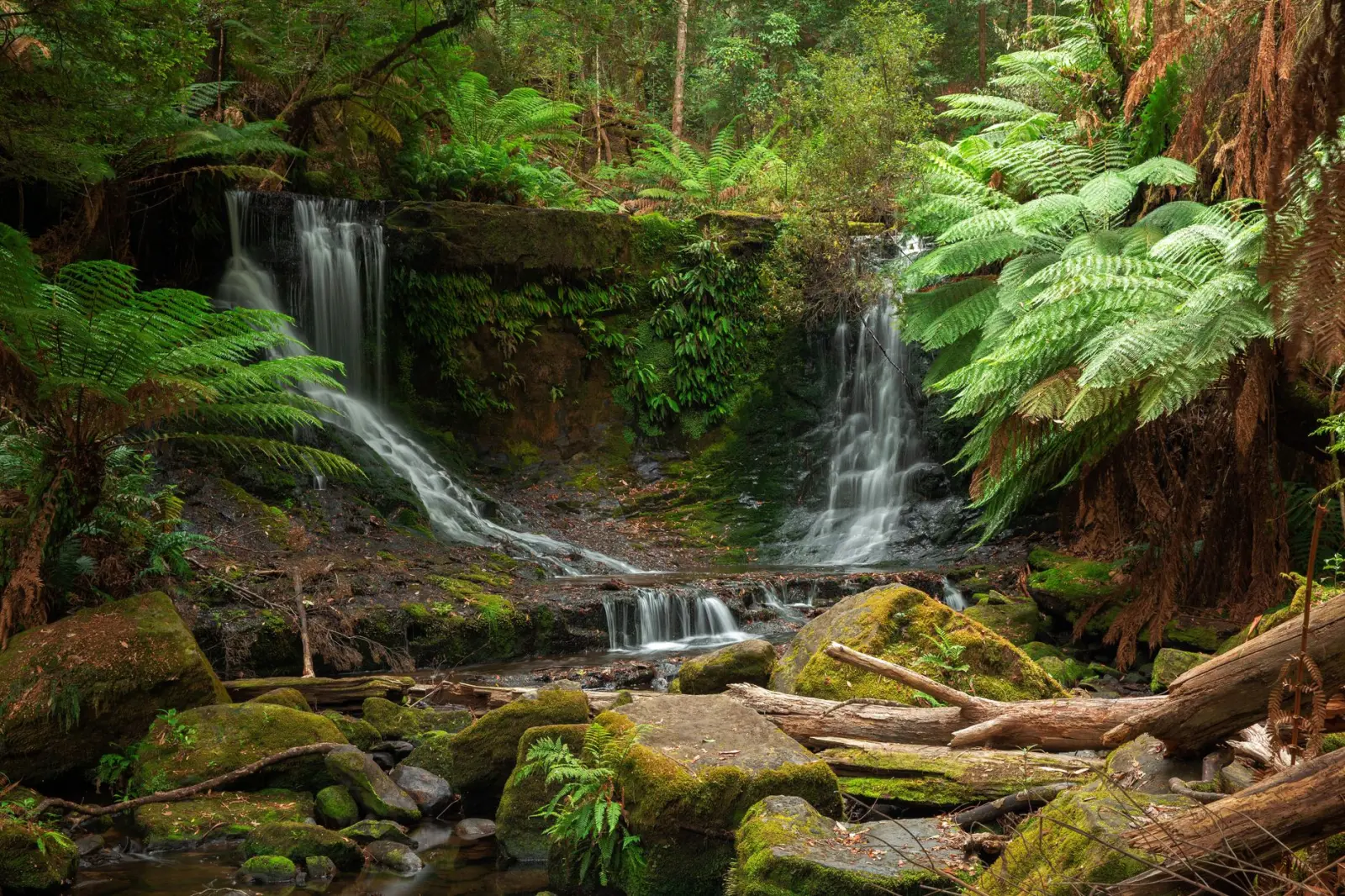
The first time you walk into a Tasmanian rainforest and look up at a 400-year-old Huon pine or a towering mountain ash, the scale doesn’t register immediately. Your eyes need several minutes to adjust to the canopy gloom, and your brain needs longer to process that you’re standing beneath something that was already mature when European settlement began. What strikes most people isn’t reverence – it’s the sheer physical density of the forest. The air feels different. Movement becomes deliberate.
These aren’t the sparse, open forests of mainland Australia. Tasmanian rainforests are wet, tangled, and unforgiving. The giant trees exist within a matrix of smaller vegetation, moss-covered logs, and ground that shifts beneath your feet. Many visitors expect to walk through a cathedral-like space with clear sight lines to ancient timber. That’s not what happens. Instead, you’re navigating a three-dimensional puzzle where the giants are present but often partially obscured by younger growth, ferns, and the sheer complexity of the understory.
The Trees That Actually Survive Here
Tasmania has several species capable of reaching genuinely impressive size, but they don’t all grow in the same conditions or at the same rate. Huon pine is the most famous – it grows slowly, lives for over a thousand years, and develops a dense, rot-resistant wood that makes it prized and historically vulnerable to logging. Mountain ash (Eucalyptus regnans) reaches the greatest heights, sometimes exceeding 80 meters, and grows faster than Huon pine. Myrtle beech and Tasmanian blackwood are common in these forests too, but they rarely achieve the same monumental proportions.
The distinction matters because it changes what you actually see on the ground. A 600-year-old Huon pine might be only 20 meters tall but possess a trunk diameter that demands two or three people holding hands to encircle it. A mountain ash of similar age will be dramatically taller but potentially thinner. The visual impact is completely different, and so is the experience of walking past them. Huon pines feel immovable and ancient in a way that registers viscerally. Mountain ash feels more like standing under a natural skyscraper – impressive but somehow less intimate.
Getting There and What the Ground Actually Feels Like
Access to the largest trees requires walking. There are no drive-through rainforest experiences in Tasmania, and there shouldn’t be. Most of the established tracks to significant old-growth forests range from 8 to 16 kilometers return, depending on which area you visit. The Tarkine, the Styx Valley, and regions around Cradle Mountain all have their own networks of walking tracks leading to notable specimens.
The ground itself is the first physical challenge that most people underestimate. Rainforest soil is rarely stable. It’s typically a spongy mix of decomposing wood, moss, and organic matter that shifts and compresses under weight. After rain – which is frequent – sections of track become genuinely boggy. Your foot doesn’t sink dramatically, but it doesn’t feel solid either. The sensation is unsettling for people accustomed to hiking on mineral soil or rock. Fatigue accumulates faster than it would on a conventional trail because your stabilizer muscles are constantly engaged. A 12-kilometer walk in a rainforest is physically more demanding than the same distance on a well-maintained mountain trail.
Mud is inevitable. Not the dramatic, thigh-deep variety, but persistent, sticky mud that coats boots and makes footing uncertain on the steeper sections. Many people wear trail runners expecting them to perform like they would on drier terrain. They don’t. The shoes fill with mud and offer minimal traction. Proper walking boots with aggressive tread are worth the weight penalty. Gaiters, which many people skip, actually serve a practical function here – they keep the mud and organic debris out of your socks and boots.
Why the Forest Feels Claustrophobic Despite Its Size
The canopy in old-growth rainforest is dense enough to create perpetual twilight. On overcast days, which is most days in Tasmania, the light quality becomes genuinely dim. Visibility ahead on the track is typically 30 to 50 meters maximum. This creates a disorienting effect where the forest feels simultaneously vast and confining. You know intellectually that you’re surrounded by enormous trees, but you can only see a small fraction of them at any given moment. The canopy overhead is a dark, indistinct mass of foliage and branches.
The humidity is high and constant. Your clothing becomes damp not from rain necessarily, but from moisture in the air. After a couple of hours, you notice that your skin feels clammy and your breathing requires slightly more effort. This isn’t dangerous for most people, but it does affect how long you can comfortably spend in the forest. Many visitors find that four to five hours of active walking is their practical limit before fatigue and the psychological weight of the environment become significant.
Sound behaves strangely in rainforest. The dense vegetation absorbs noise, so the forest feels quiet despite the presence of birds and small animals. Voices carry poorly. This acoustic deadening contributes to the sense of isolation. You feel removed from the world even though you’re on a marked track with other people potentially nearby.
The Scale Question and Photography
Photographing these trees presents a genuine problem. A camera cannot capture the experience of standing at the base of a 2,000-year-old Huon pine and looking up. The image always flattens the experience. Wide-angle lenses distort the proportions. Standard lenses fail to convey the height. Many people spend significant time trying to photograph the trees and end up frustrated because no image conveys what they felt standing there. This is worth accepting before you arrive. The experience is embodied and spatial in ways that don’t translate to two dimensions.
The giants are also often positioned in ways that make photography awkward. They might be partially surrounded by younger growth, or positioned on a slope that prevents you from getting far enough back to frame them properly. The best views are often from the side or at an angle rather than straight-on. This is another reminder that these forests aren’t designed for human convenience or aesthetic composition.
Timing and Seasonal Considerations
Summer (December to February) is the most accessible period. The days are longer, temperatures are milder, and rainfall is slightly lower than other seasons. However, summer also brings the most visitors. The tracks become more crowded, and the sense of solitude diminishes. Winter (June to August) is genuinely cold and wet. Snow is possible in higher-elevation areas, and track conditions deteriorate. Spring and autumn are intermediate options – fewer visitors than summer, more stable conditions than winter, though rain remains probable.
The rainforest itself changes very little seasonally. The trees are evergreen. The understory remains dense year-round. What changes is your physical capacity to move through it comfortably and the likelihood of encountering other people. If solitude and minimal crowds matter to you, visiting in shoulder seasons or even early winter is worth the additional physical challenge.
After years of walking through these forests, the thing that remains consistent is the sense of time operating differently under the canopy. The trees are old enough that human timescales feel briefly irrelevant. That’s not a poetic observation – it’s a practical one. It changes how you move and how long you’re willing to stay. The experience demands patience and a willingness to move slowly, both physically and mentally.