
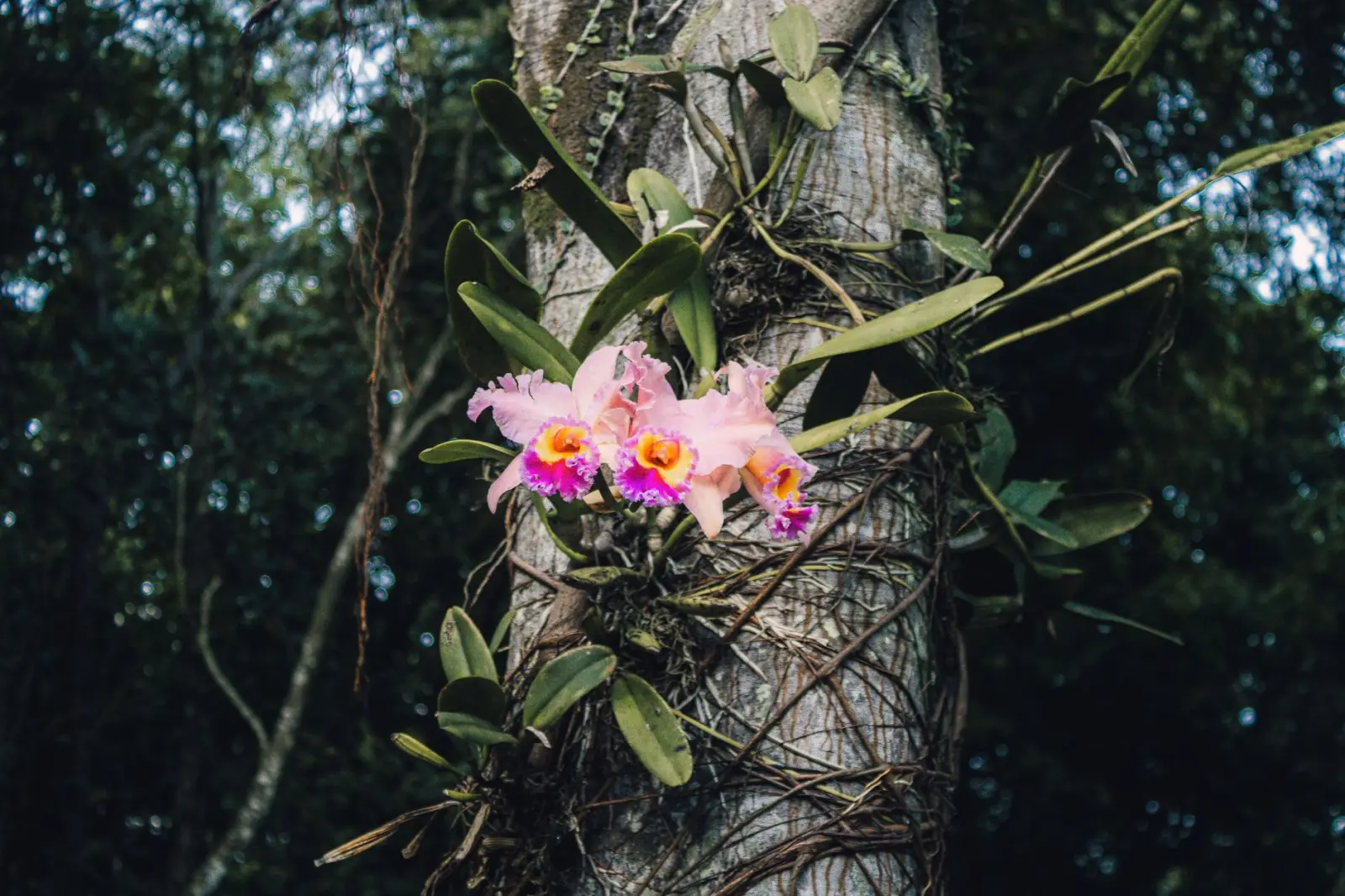
Spend enough time walking through a wet forest, and you stop noticing individual trees. Instead, you notice the weight of life hanging from every branch – orchids, bromeliads, ferns, mosses, lichens, all suspended in the canopy without touching soil. After years of field work in these systems, the pattern becomes obvious: epiphytes don’t just survive in wet forests. They flourish there in ways that seem almost impossible in drier climates. The question isn’t really why they exist in these places. It’s why the conditions are so favorable that they become dominant features of the forest structure itself.
The fundamental advantage wet forests offer epiphytes is constant access to moisture. In a tropical rainforest, humidity rarely drops below 80 percent, and often stays near saturation. This matters far more than occasional rain events. An epiphyte – a plant that grows on another plant without parasitizing it – has no root system reaching into soil reserves. It depends entirely on capturing water from the air, from leaf surfaces, and from whatever moisture accumulates in crevices and bark. In a wet forest, this water is nearly always available. In a seasonal or dry forest, an epiphyte would face months of desiccation stress that most species simply cannot tolerate. The constant humidity in wet forests removes this constraint almost entirely.
Moisture capture and retention
The way epiphytes actually access water reveals why wet forest conditions are so permissive. Most epiphytes have adapted to absorb moisture directly through their leaves and aerial roots, bypassing the need for soil uptake. Bromeliads collect water in their leaf rosettes, creating small reservoirs. Orchids have velamen – a spongy root tissue that absorbs water from humid air and moisture-laden bark surfaces. Mosses and lichens function as passive sponges, swelling with water when humidity is high and drying out when it drops. In a wet forest, these mechanisms work nearly continuously. The epiphyte isn’t in a constant state of physiological stress, managing scarcity. It’s in a state where water acquisition is almost passive.
This has a cascading effect on energy allocation. A plant that doesn’t have to invest heavily in drought-tolerance mechanisms can invest more in growth and reproduction. You see this in the sheer biomass of epiphytes in wet forests – entire trees can be so densely covered that the host plant’s own leaves are partially shaded by the epiphyte community. In drier forests, epiphytes exist, but they tend to be smaller, more scattered, and more specialized. In wet forests, they become a dominant structural component.
Light availability and forest architecture
A second factor that surprises people is light. The wet forest canopy is dense, and direct sunlight rarely penetrates to the understory. Yet this is precisely the condition that allows epiphytes to thrive. Most epiphytes are shade-tolerant plants. They’ve evolved to photosynthesize efficiently under low-light conditions. In a wet forest, they receive dappled, diffuse light filtered through multiple layers of leaves. This is their ideal light regime. In a savanna or dry forest, where trees are more spaced and light is intense and direct, many epiphytes would be exposed to excessive photosynthetically active radiation and would suffer from photobleaching or heat stress.
The architecture of wet forest trees also matters. Trees in wet forests tend to have thinner, more delicate bark and more horizontal branching than trees in drier climates. This creates more surface area and more stable perches for epiphytes to colonize. The bark is also often covered in moss and algae, which creates a favorable microhabitat for epiphyte establishment. A seed landing on smooth, dry bark in a savanna has little chance of germination. A seed landing on moss-covered, moisture-retentive bark in a wet forest has a reasonable chance of establishing.
Nutrient cycling in the canopy
What often gets overlooked is the nutrient dimension. Epiphytes don’t have access to soil nutrients. Yet wet forests are nutrient-rich systems, and epiphytes have evolved to capture nutrients from multiple sources. They intercept nutrients from canopy-drip – water running down leaves and branches carries dissolved minerals. They accumulate organic matter in their leaf rosettes and root systems, creating small pockets of nutrient-rich substrate. Many epiphytes, particularly orchids and bromeliads, host complex communities of insects, fungi, and bacteria that cycle nutrients within the epiphyte itself. Over time, dead leaves and organic matter accumulate around epiphyte roots, creating a miniature soil-like environment suspended in the canopy.
In a wet forest, this organic matter doesn’t dry out and decompose rapidly. It stays moist, allowing slow, steady nutrient cycling. Fungi colonize this material, making nutrients available to the epiphyte. The result is a self-sustaining nutrient system that would be impossible in a dry climate where decomposition is rapid and water is scarce. An epiphyte in a wet forest can actually accumulate more biomass and support more dependent organisms than a terrestrial plant of similar size in a drier region.
The role of host tree stability
The permanence of the host tree is another practical advantage. In a wet forest, trees grow continuously and live for centuries. An epiphyte that establishes on a branch can reasonably expect that branch to persist for decades. The host tree provides a stable platform. In a seasonal forest where trees lose leaves or experience significant stress, branches are more likely to break or die back. An epiphyte that invests in establishing on a branch that might die within a few years is making a risky bet. In a wet forest, the bet is much safer.
This stability also allows epiphyte communities to mature and become structurally complex. Old-growth wet forests often have epiphyte communities so thick that they form a secondary canopy layer. Orchids, bromeliads, ferns, and mosses create a multi-layered ecosystem suspended above the forest floor. This complexity only develops when conditions remain favorable for decades. In drier forests, epiphyte communities tend to remain simpler and more transient.
After working in both wet and dry forest systems, the pattern is clear: epiphytes don’t thrive in wet forests because of a single factor. They thrive because multiple conditions align simultaneously – constant moisture, appropriate light, stable hosts, and favorable nutrient cycling. Remove any one of these, and the epiphyte community becomes less diverse and less abundant. The wet forest creates a permissive environment where the constraints that limit epiphytes elsewhere simply don’t apply. This is why the canopy of a rainforest feels so alive with suspended plant life, while the canopy of a dry forest feels sparse by comparison.