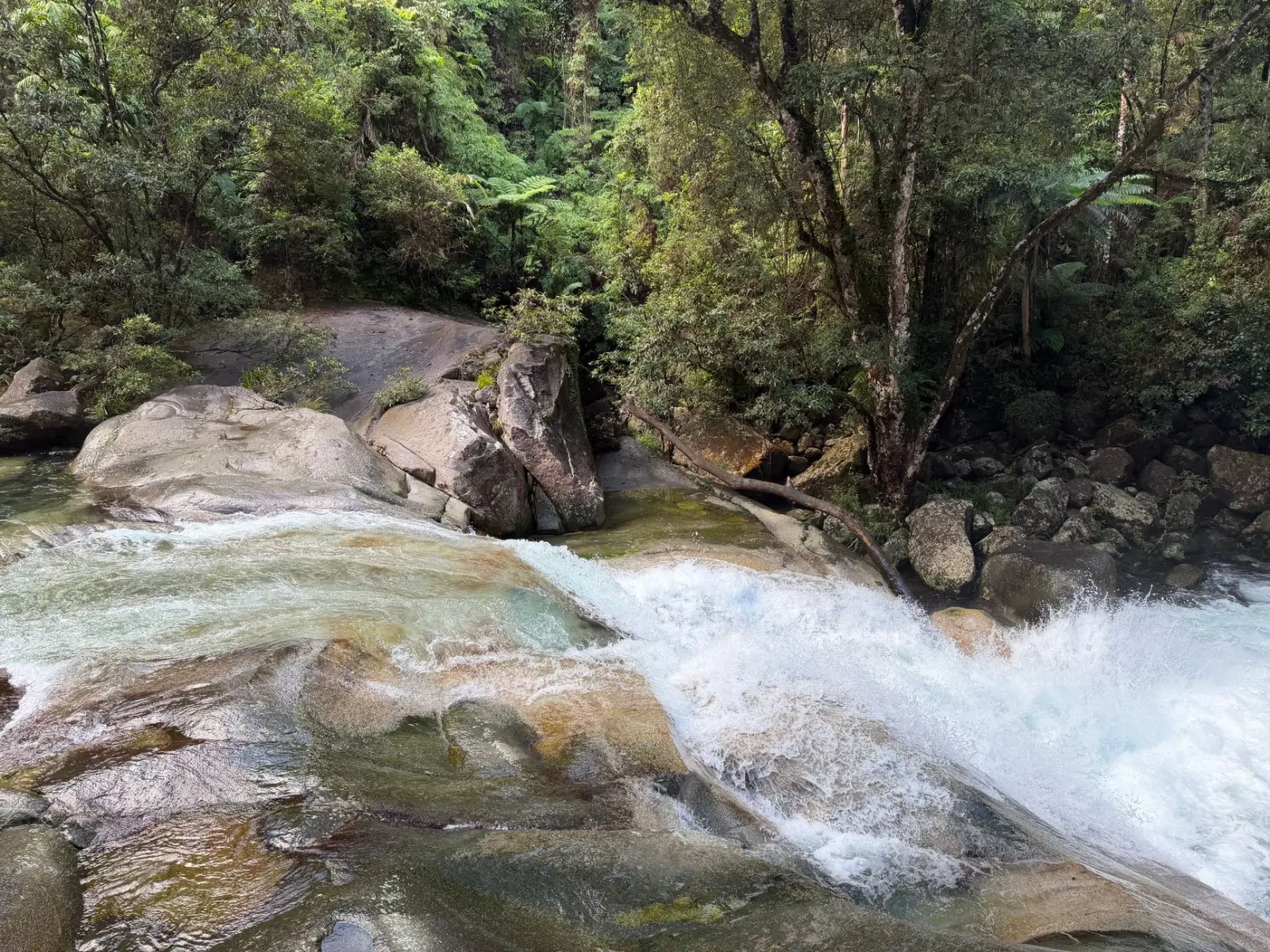
After spending years moving through the Wet Tropics in far north Queensland, you begin to understand why this place resists easy categorization. It’s not simply a rainforest. It’s a living archive of evolutionary processes that have unfolded across millions of years, and the density of what survives here – species, genetic material, ecological relationships – exists nowhere else on Earth in quite the same configuration. The World Heritage designation matters, but not for the reasons most people assume when they first hear the term.
The Wet Tropics covers roughly 900,000 hectares along the Queensland coast between Cooktown and Townsville. On a map, it looks like a thin green strip pressed against the Great Dividing Range. In reality, it’s a landscape of extraordinary complexity. Rainforest transitions into wet sclerophyll forest, which grades into open woodland. Altitude changes dramatically over short distances. Rainfall varies by orders of magnitude depending on which side of the range you’re on. This variation, compressed into a relatively small geographic area, is what makes the region biologically extraordinary.
What distinguishes the Wet Tropics from other rainforest regions is age and isolation. These forests have persisted through multiple climate cycles over the past 15 to 20 million years. When other rainforests contracted during drier periods, fragments of the Wet Tropics remained, creating refugia where species could survive. Over time, this created conditions for high levels of endemism – species found nowhere else. Walk through the understory and you’re surrounded by plants and animals that exist only here. That’s not poetic exaggeration; it’s a measurable ecological fact that shapes everything about conservation strategy in the region.
The Problem with Fragmentation
The real conservation challenge in the Wet Tropics isn’t what most visitors see when they drive through. The forests look intact. The canopy is dense. Wildlife is present. But beneath that surface, fragmentation has already altered the landscape in ways that take years of observation to fully grasp.
Before European settlement, the Wet Tropics rainforest was continuous from the coast to the high country. Today, it exists as a series of patches separated by cleared land, agricultural areas, and developed zones. This fragmentation matters because many species in the Wet Tropics have small home ranges and low dispersal ability. A cassowary might spend its entire life within a few square kilometers. A tree frog species might occupy only a handful of rainforest patches. When populations become isolated, they lose genetic diversity. Small populations are vulnerable to local extinction from disease, climate variation, or random demographic events.
The World Heritage listing created legal protection for the core rainforest areas, but it didn’t restore connectivity. Corridors between patches remain incomplete. Some species that historically moved between forest areas now encounter barriers they cannot cross. This is where the conservation value of the designation becomes practical rather than symbolic. The protected area provides a baseline – a place where habitat loss is legally constrained. Without it, clearing would have continued, and the fragmentation would be far worse.
Endemism and Evolutionary Significance
The concentration of endemic species in the Wet Tropics is staggering when you start to examine the numbers. Over 30 percent of Australia’s mammal species occur here, despite the region representing less than 0.3 percent of the continent’s land area. For birds, the proportion is similar. For plants, endemism rates reach levels that rival tropical rainforests anywhere in the world. Many of these species are ancient lineages – living fossils, in a sense – that represent evolutionary pathways that have disappeared elsewhere.
This matters for conservation because you’re not just protecting current biodiversity; you’re protecting the evolutionary potential embedded in these populations. Some of the plants in the Wet Tropics have chemical compounds that have never been synthesized or studied. Some of the insects represent taxonomic groups that are poorly understood globally. From a purely pragmatic standpoint, you’re protecting genetic resources and biological knowledge that could have applications in medicine, agriculture, or other fields. But beyond utility, there’s a deeper principle: these species and lineages represent millions of years of evolutionary history. Once lost, they cannot be recovered.
Climate Refugia and Future Resilience
One of the most important functions the Wet Tropics serves is often invisible to casual observation. The region acts as a climate refugium. During past climate shifts, species survived here while they disappeared from surrounding areas. This capacity to buffer species against climate change is becoming increasingly valuable as global temperatures shift.
The topographic complexity of the region means that species can shift their ranges vertically along the slopes. As temperatures warm, a species can move upslope to find cooler conditions. This vertical migration is possible in the Wet Tropics in ways it isn’t in flatter rainforest regions. The protected status of the World Heritage Area means that this vertical connectivity – from lowland rainforest to high-altitude forest – remains intact. Without protection, clearing at intermediate elevations would have severed these pathways, eliminating the region’s capacity to function as a climate refuge.
This function becomes more critical as climate change accelerates. Species that have nowhere else to go will depend on places like the Wet Tropics to provide suitable habitat as conditions shift. The World Heritage designation doesn’t prevent climate change, but it preserves the landscape structure that allows species to respond to it.
Indigenous Knowledge and Long-term Management
The Wet Tropics has been inhabited by Aboriginal peoples for at least 9,000 years, and likely much longer. This isn’t incidental to the conservation story; it’s central to understanding how the landscape has been maintained. Indigenous fire management, selective harvesting, and detailed ecological knowledge shaped the structure and composition of the rainforest long before conservation became a formal discipline.
The World Heritage listing, in its more recent iterations, has increasingly recognized this reality. Co-management arrangements between Indigenous groups and conservation agencies have become more common. This matters because Indigenous land management practices often sustain biodiversity more effectively than hands-off preservation alone. The knowledge embedded in Indigenous communities about species behavior, seasonal patterns, and ecological relationships is irreplaceable. Formal protection of the area creates a framework within which this knowledge can be applied and transmitted across generations.
When you spend time in the Wet Tropics with Indigenous guides or rangers, you encounter an entirely different understanding of the landscape than you would from a purely Western scientific perspective. Both are valuable. The combination of Indigenous knowledge and scientific monitoring provides a more robust basis for long-term conservation than either alone.
The Wet Tropics World Heritage Area matters because it protects something that cannot be easily replicated or restored once lost. It’s not a pristine wilderness – the landscape has been shaped by human activity for millennia and continues to be affected by external pressures. But it’s a place where the full complexity of rainforest ecology, evolution, and cultural knowledge remains intact enough to sustain itself and to teach us about how tropical ecosystems function. The designation provides legal standing to resist further fragmentation and degradation. That might sound modest, but in a world where most natural areas face constant pressure for conversion and use, legal protection is often the difference between persistence and collapse.